13.7.6 Estimates of illicit cigarette trade in Australia
13.7.6.1 Australian reports on seizures by government agencies
Reports on seizures of tobacco products by the Australian Border Force (ABF) since 2006–07 are set out in Table 13.7.4 and Figure 13.7.2 below.
Table 13.7.4 Quantities of tobacco in tonnes (also expressed as estimated numbers of cigarette equivalents (millions)) seized by Australian customs authorities, 2006–07 to 2022–23
|
2006–07
|
67.4
|
39,800,000
|
99.3
|
124.1
|
|
2007–08
|
287.5
|
106,800,000
|
372.9
|
466.1
|
|
2008–09
|
175.4
|
50,177,640
|
215.5
|
269.4
|
|
2009–10
|
310.7
|
68,728,000
|
365.7
|
457.1
|
|
2010–11
|
258.0
|
82,000,000
|
323.6
|
404.5
|
|
2011–12
|
177.0
|
141,000,000
|
289.8
|
362.3
|
|
2012–13
|
183.0
|
200,000,000
|
343.0
|
428.8
|
|
2013–14
|
178.0
|
147,000,000
|
295.6
|
369.5
|
|
2014–15
|
150.0
|
40,000,000
|
182.0
|
227.5
|
|
2015–16
|
^
|
^
|
147.2
|
184.0
|
|
2016–17
|
139.0
|
215,000,000
|
358.1
|
388.8
|
|
2017–18
|
215.0
|
235,000,000
|
432.9
|
503.8
|
|
2018–19
|
^
|
^
|
631.3
|
789.1
|
|
2019–20
|
^
|
^
|
484.7
|
605.8
|
|
2020–21
|
^
|
^
|
1,248.5
|
1,560.6
|
|
2021–22
|
^
|
^
|
1,678.5
|
2,098.1
|
|
2022–23
|
^
|
^
|
2,111.5
|
2,639.4
|
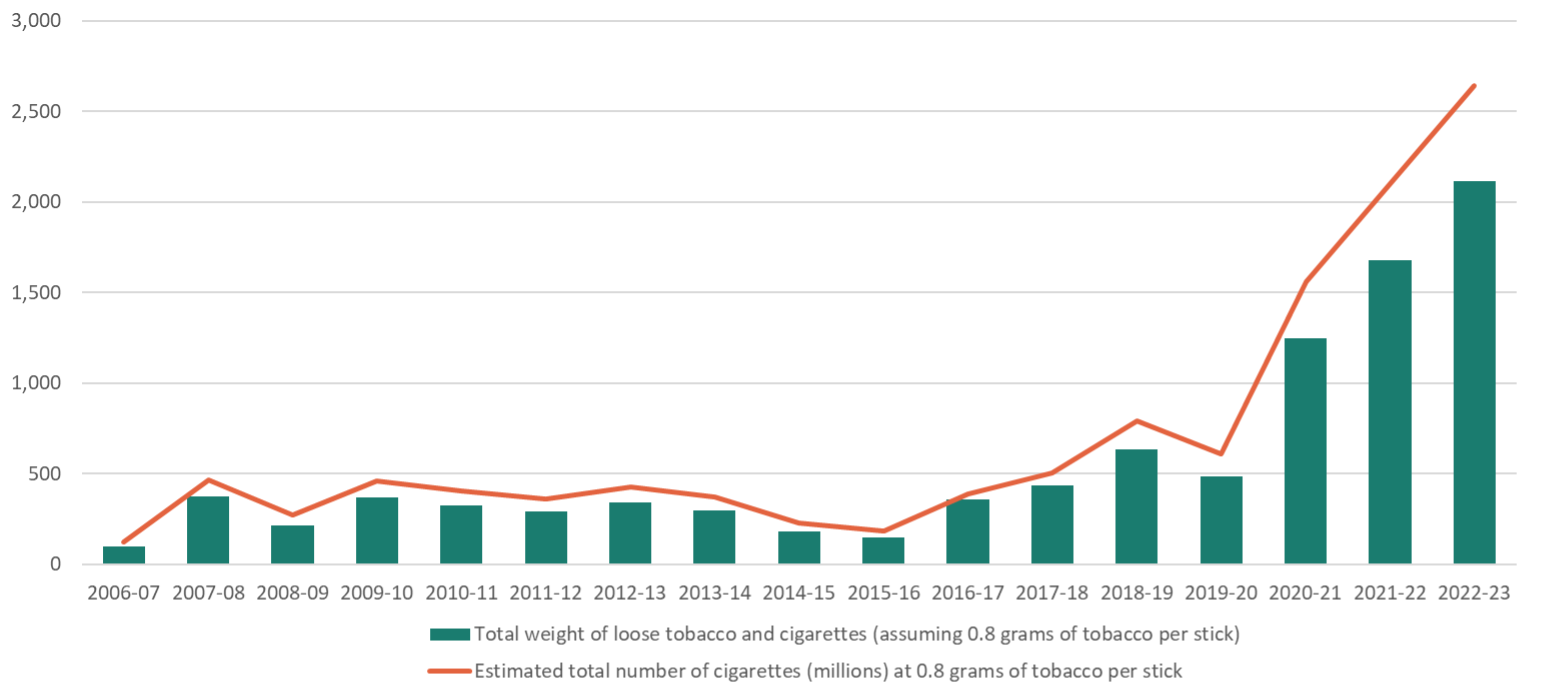
Figure 13.7.2. Total weight of tobacco (also expressed as estimated number of cigarette equivalents (millions)) seized by Australian customs authorities, 2006–07 to 2022–23
The Australian Taxation Office publishes outcomes of the illicit tobacco enforcement activities undertaken by the multi-agency Illicit Tobacco Taskforce (ITTF), established in July 2018—see Section 13.7.9.3.The number of tobacco seizures, quantity of tobacco, and estimated excise duty value of the seized tobacco, and associated convictions, is reported in Table 13.7.5.
|
2018–19
|
8
|
41,400
|
Nil
|
42
|
4
|
|
2019–20
|
22
|
130,656
|
11,480
|
171
|
4
|
|
2020–21
|
23
|
109,186
|
5,496,379
|
178
|
1
|
|
2021–22
|
21
|
110,349
|
1,661,520
|
176
|
1
|
|
2022–23
|
16
|
66,711
|
1,207,516
|
111
|
6
|
|
2023–24*
|
19
|
3,732
|
9,467,091
|
15
|
4
|
13.7.6.2 Tobacco tax gap
The Australian Taxation Office released an independent assessment of the extent of use of illicit tobacco in Australia in October 2022. 17 The ATO used a 5-step model-based bottom-up method to estimate the tobacco tax gap. 117
Step 1: Estimate illicit tobacco arriving through importation
Step 2: Estimate the size of domestic chop-chop cultivation
Step 3: Analyse the licensed warehouse system
Step 4: Compare total illicit amounts to legal clearances
Step 5: Deduct seizures to determine net gap
The findings of the ATO’s latest independent assessment of the extent of use of illicit tobacco in Australia is presented in Table 13.7.6. There was $5.203 billion in potential lost excise revenue in 2021–22, including seized illicit tobacco. The lost excise revenue from illicit tobacco that did enter the Australian market was estimated to total $2.343 billion. This compares to the $3.4b claimed by the industry-funded FTI Consulting report for 2022 118 – see Section 13.7.4.2.
|
Gross gap ($m)
|
980
|
1310
|
1744
|
2118
|
3991
|
5203
|
|
Seizures of illicit tobacco ($m)
|
359
|
473
|
708
|
784
|
2090
|
2860
|
|
Net gap ($m)
|
621
|
837
|
1036
|
1334
|
1901
|
2343
|
|
Duty paid ($m)
|
10612
|
11914
|
12147
|
12781
|
14264
|
12659
|
|
Theoretical liability ($m)
|
11592
|
13224
|
13891
|
14889
|
18255
|
17862
|
|
Gross gap (%)
|
8.5
|
9.9
|
12.6
|
14.2
|
21.9
|
29.1
|
|
Net gap (%)
|
5.4
|
6.3
|
7.5
|
9.0
|
10.4
|
13.1
|
Limitations of theoretical tax
The ATO acknowledged that illicit tobacco smokers may smoke less if they must pay the higher legal price that includes excise duty. This would affect the amount of duty recoverable if the illegal market were eliminated.
The gross gap refers to illegal tobacco entering the market, including tobacco seized by authorities. If all efforts to prevent illegal tobacco stopped, the same volume of illicit tobacco would likely exceed current consumer demand. Earnings would then plummet, making the provision of illicit tobacco less appealing. If the same quantity of tobacco entered the market legally, volume would drop. This is because excise duty reduces profitability. Legal importations have fallen during the previous six years.
13.7.6.3 Estimates of illicit tobacco use or purchase from the National Drug Strategy Household Survey (NDSHS)
The National Drug Strategy Household Survey (NDSHS) is a national representative survey of Australians, and collects information about awareness and use of illicit tobacco. Findings from the 2022–23 NDSHS119 are presented in below.
Table 13.7.7 shows that the proportion of people who currently smoke aged 14 years or older who were aware of unbranded (chop-chop) tobacco significantly increased from 34.1% in 2019 to 43.3% in 2022–23. Current use of unbranded tobacco among current smokers was 1.8 times higher in 2022–23 compared to 2019. Among those current smokers who were aware of unbranded tobacco, current use increased by 44% from 14.4% in 2019 to 20.7% in 2022–23.
Table 13.7.7 Awareness and use of unbranded (chop-chop) tobacco among people who currently smoke aged 14 years and over, Australia, 2013 to 2022–23
|
Aware of unbranded tobacco
|
33.9
|
33.1
|
34.1
|
43.3
|
|
Currently use unbranded tobacco
|
3.6
|
3.8
|
4.9
|
9.0
|
|
Previously used unbranded tobacco
|
12.9
|
12.7
|
12.8
|
14.3
|
|
Never used unbranded tobacco
|
83.5
|
83.5
|
82.3
|
76.7
|
|
Currently use unbranded tobacco
|
10.7
|
11.4
|
14.4
|
20.7
|
|
Previously used unbranded tobacco
|
38.0
|
38.4
|
37.5
|
33.0
|
|
Never used unbranded tobacco
|
51.4
|
50.2
|
48.1
|
46.3
|
Use and awareness of manufactured illicit tobacco, that is, packs that do not comply with Australia’s plain packaging and graphic health warning requirements, has also increased since 2019. Figure 13.7.3 shows that in 2022–23, one in five current smokers had seen packs without plain packaging in the past 3 months, up from 15.2% in 2019. The proportion who had purchased such a pack in the past 3 months also increased from 6.2% to 10.2%. As a proportion of the total Australian population aged 14+ years, 1.4% had recently purchased a tobacco product without plain packaging.
Figure 13.7.3 Proportion of people who had seen or purchased tobacco products without plain packaging in the past 3 months, current smokers and Australians aged 14+ years, 2013 to 2022–23

Of current smokers who had recently purchased a product without plain packaging, approximately 39% had purchased 15 or more packs in the past 3 months (a minimum of one pack every 6 days), 31% had purchased 1 or 2 packs, and 17% had purchased 3 to 5 packs.120
Figure 13.7.4 shows the usual place of purchase of packs that did not have plain packaging or graphic warnings, for current smokers who had made a purchase in the past three months. The proportion who usually purchased illicit tobacco from a tobacconist was 1.6 times higher in 2022–23 than 2019, increasing from 25.2% to 40.1%. An increase in the proportion purchasing from informal sellers also increased, while the proportion who usually purchased from a supermarket, convenience or grocery store decreased by one-third.
Figure 13.7.4 Usual place of purchase of packs without plain packaging, among of people who had purchased tobacco products without plain packaging in the past 3 months, 2013 to 2022–23

13.7.6.4 Measuring changes in illicit tobacco use following plain packaging
A series of studies conducted to evaluate the effects of plain packaging in Australia used several ways to define and monitor use of likely illicit tobacco through small retail outlet monitoring and a national survey.121 ,122 77
The small retail outlet monitoring study122 examined changes in the availability of illicit tobacco in small mixed-business retail outlets in Victoria following the introduction of plain packaging in 2012 in Australia. Fieldworkers 1) requested a particular low-cost brand of cigarettes and then pressed the retailer for an ‘even cheaper’ brand, and 2) asked about the availability of unbranded (chop-chop) tobacco. The cheapest pack of cigarettes was bought and evaluated for compliance with Australian packaging regulations. Tax liabilities and recommended retail prices were compared to the price paid for the brand and pack size.
The percentage of packs purchased that were either non-compliant with Australian health warnings and/or suspiciously priced in pre-plain packaging was 2.2% (13/598 packs purchased). The percentages of packs that satisfied either or both requirements was 1.3% (4/297 packs purchased) in the implementation month and 0.6% (5/878 packs) in the three collection months after introduction. The availability of chop-chop was extremely rare both in implementation month (December 2012) and postimplementation (0.6%; n=2 and 0.6%; n=3, respectively). A follow-up study in tobacconists found very few offers to sell chop-chop tobacco (3.1%) in 2013.78
Using a national representative survey,121 illicit tobacco use was measured in four ways in 2012–2014, to assess changes in illicit tobacco use following the implementation of Australia’s plain packaging legislation. Participants were asked to give the brand name, pack size, price paid, and place of purchase, of the last cigarette they smoked.
- ‘Cheap whites’
Nominated cigarette brands were examined against a list of ‘cheap white’ products produced specifically for the illicit market using the World Customs Organization Illicit Trade Report 2012 and reports by the international consulting company KPMG LLP. Cheap white cigarettes are made in one country and smuggled into other countries and sold on the illicit market.123 Names of Cheap white products included Dunstan, Jin Ling, Manchester, Modern, Regal, Sunlite, Timeless Time, Win, YunYan, Zhongnanhai, Nanjing, Su Yan, and Zig Zag
- International brands purchased at suspiciously low prices
Nominated cigarette brands were compared to list of frequently smuggled brands from the World Customs Organization.123 These brands included Benson & Hedges, Brooks, Camel, Craven A, Dunhill, Furongwang, Golden Eagle, LM, Lucky Strike, Marlboro, Mild Seven, Phillip Morris, Rothmans, Shuangxi, and 555.
Suspiciously low prices were defined as the reported price paid being 20% or more below the recommended retail price (RRP) for the pack for these brands.
- Purchase from informal sellers
that relatives or friends had purchased their cigarettes and reported purchase sources including ‘from someone selling independently and/or illegally (not at a store, shop, or other mainstream establishment, but perhaps at local markets, delivery service, door-to-door, in a pub, or just in the street)’.
- Unbranded illicit ‘chop-chop’ tobacco
Indirect and direct questions were used to define the use of unbranded illicit tobacco as indicating any of the following throughout the survey:
-
- Cigarette users were asked whether they currently smoked any other form of tobacco and, if so, which types: Some respondents mentioned unbranded tobacco.
- Cigarette users could also report ‘unbranded tobacco’ as their ‘current brand’, usual brand (the brand they smoked more than any other), or ‘another brand’ they frequently smoked.
- Those who said they did not know the brand name or refused to give it were directly asked whether it was unbranded tobacco.
- Reporting an unbranded tobacco or cigarette purchase in the past month through a direct question (“bought loose unbranded tobacco in a plastic bag that is known as chop-chop” or “bought unbranded or chop-chop tobacco that has already been rolled into cigarettes”).
Compared to pre-plain packaging, there were no significant increases in the plain packaging phase in use of "cheap whites" (<0.1%; OR=0.24, 95% CI 0.04 to 1.56, p=0.134); international brands purchased for 20% or more below the recommended retail price (0.2%; OR=3.49, 95% CI 0.66 to 18.35, p=0.140); or packs purchased from informal sellers (<0.1%). Unbranded illegal tobacco use was maintained at 3% (adjusted OR=0.79, 95% CI 0.58 to 1.08, p=0.141).
13.7.6.5 Estimates using publicly available data
More recently, a ‘top-down’ approach was used estimate the size of the illicit cigarette market in Australia using publicly available data.124
The study estimated the size of the illicit cigarette market by deducting formal net clearances from total consumption and expressed both a number of sticks and a percentage of the total market. The study authors used Euromonitor’s estimates of actual consumption (cigarette sticks) per year and clearance data posted online by the Department of Home Affairs (DOHA) in response to a request under Freedom of Information (FOI) provisions. They assumed the balance from this calculation was illicit tobacco consumption.
Illicit sticks = Actual consumption (sticks) - formal 'net' clearances FOI
They found that the illicit tobacco market share was 5.7% in 2015, 4.4% in 2016 [ii], 8.3% in 2017 and 6.6% in 2018. These estimates were closer to the ATO’s estimates and substantially lower than KPMG’s for Australia during the same period. The measurement of overall cigarette consumption, including the quantification of illegal cigarette penetration, conducted by Euromonitor, is subject to an over-dependence on its methodology. The available data of overall tobacco consumption is restricted solely to cigarettes, and does not account for roll-your-own tobacco use.
13.7.7 What is known about drivers of illicit trade in tobacco internationally?
As pointed out by a study published in Journal of Business Research in their analysis of business strategies in the counterfeit market,125 those involved in the supply of illicit cigarettes are generally anxious to avoid detection by authorities and therefore must be careful to hide their operations. This makes it difficult for large numbers of consumers to be aware of and purchase their products. While threat of seizures is unlikely to be a major concern, fine and jail times for individuals is likely to reduce the supply of people willing to be involved and increase the costs demanded by those who are involved, thus increasing the likely cost of the product. For potential suppliers who are willing to consider trading in illicit tobacco products and have the means to do so, the decision about whether or not to actually engage in such activity is still not an automatic one. Individuals are likely to consider not simply the price they could charge for products in the illicit market but rather the profit that they could expect to make once costs are deducted from income.126 The greater the expected rewards and the lower the costs, the more likely an individual prepared and able to be involved in illegal activity is to actually engage in such activity.10 ,127 ,128
The prices that suppliers can charge consumers for illicit products are determined partly by the prices of products in the legal market. But the prices suppliers can charge are also affected by the perceived consistency of quality and supply of the illicit goods and the costs to the consumer in terms of time and travel and any perceived risks associated with purchase (e.g. contact with those involved in crime, fear of detection by authorities and so on).125 ,129
The costs for the supplier to be involved in the illicit tobacco market include
- direct costs such as money required to bribe officials or other operators in the illicit trade
- opportunity costs such as salary forgone from other possible employment and other potential use of capital (growing land, equipment, factory space, boats and the like)
- a judgment about the probability of detection in relation to the magnitude of penalties and social opprobrium of being prosecuted.
These three considerations are likely in turn to be affected by factors relating to the nature of international trade, transport and distribution channels, cultural norms relating to bribery and corruption, government diligence in record keeping, investment in law enforcement and the individual’s attitude to the prospect of jail time.10
Nature of international trade
Illicit trade can be more attractive in situations where
- restrictions on the supply of imported tobacco (through the imposition of quotas, tariffs and other non-tariff barriers) lead to significant price differentials between imported and locally manufactured tobacco
- tobacco products intended for export are significantly cheaper than those intended for local consumption.
Detection of illicit cigarettes is more difficult where there is a large volume of international trade with only a small percentage of cargo subject to checks.
Empirical research conducted in 2017 emphasised the importance of special economic zones, particularly free trade zones, in the illicit tobacco trade known to predominantly involve smuggling of illicit tobacco products and illicit manufacture of tobacco products within zones themselves.130 The Financial Action Taskforce of the Organization for Economic Co-operation and Development estimated that there were about 3000 free-trade zones in 135 countries in 2009.131 ,132 In 2014, the World Customs Organization (WCO) launched its first global operation into the illicit tobacco trade, codenamed Gryphon, which confirmed the importance of free trade zones in the smuggling of cigarettes.
‘Consignments arriving in these zones are subsequently repacked into other containers, enabling the illicit cigarettes to be lost or disappear. They then leave the zone as low-value goods (e.g. textiles) either mis-declared or concealed in other shipments’ (WCO, 2014) [iii]
The International Consortium of Investigative Journalists documented cases of smuggling through free-trade zones on the island of Aruba, and in Columbia (Beelman 2000 cited by IARC)10 and the US Financial Action Task force identified smuggling through China to the US through a free-trade zone in Hawaii.131
Logistical factors
Evasion can sometimes occur in situations where people suddenly find themselves under financial pressure and in possession of the immediate means to be involved in the illicit market. This occurred in Australia when tobacco companies reduced prices paid and then stopped buying from Australian tobacco growers, some of whom then turned to growing chop-chop.133 It also occurred after China joined the World Trade Organization and the products of small regional factories in China were no longer competitive.134
Costs of production of cigarettes are quite small, and technological advances in printing has made counterfeiting easier than it used to be. However, obtaining raw materials (particularly the tobacco) and moving stock out of premises would be difficult to conceal in most locations.
Products that need to be cleared through major shipping ports are more likely to be scrutinized by customs officials than are products travelling by road or rail. Distribution of illicit products is likely to be easier in countries with highly developed illicit markets for other products and a well-developed network of street sellers and small market stall holders.
Poor record keeping
A loose export–import recording system and lax work practices and supervision reduce the likelihood of detection of illicit tobacco.
Law enforcement perceived as lax
Evidence reviewed in the International Agency for Research on Cancer10 suggests that the relationship between perceived risk of prosecution and likelihood of engaging in the illicit tobacco trade is not a linear one. Rather there may be a threshold interception rate beyond which the rate of smuggling rapidly declines.
Poverty
In some developing countries and among some impoverished groups in high income countries, some smugglers may be undeterred by very high levels of risk if the return from smuggling exceeded the likely lost earnings due to time in jail. However in wealthier countries the economics of tax evasion are much more precarious.125
Political instability, corruption, war and organised crime
Criminal networks involved in smuggling operate more easily in countries where corruption is high or government controls are eroded by war or political instability, and such groups are well placed to become involved in the illicit tobacco trade. Illicit market cigarettes were an important source of income for people during periods of war in the Balkans.135 Using indicators of corruption based on an index created by international non-government organisations, a 2010 working paper by World Bank72 observed that contraband sales tend to increase not with tax levels or cigarette prices but rather with the degree of corruption in any country.132 ,136
13.7.8 What do international authorities recommend to address the illicit trade in tobacco?
This section summarized material from the World Bank and International Monetary Fund, and then sets out elements of the World Health Organization’s FCTC Protocol on Illicit Tobacco.
13.7.8.1 Best practice tax administration to prevent illegal trade
A chapter in a 2019 World Bank report discusses the International Monetary Fund's perspective on tobacco tax administration and illicit trade.1
The general concern in the administration of value-added taxes and excise taxes on tobacco is to carefully monitor the importation, manufacture, and distribution of taxed items. This control should be applied across the supply chain, from the fields where tobacco is grown to the point of entry to the final purchase by the individual customer. Clear legal frameworks and revenue administration services or functions are needed for such controls.
The World Bank1 suggested a legal framework with the following key elements:
- Tobacco product categories and specific items subject to excise taxation must be precisely defined, taking into account likely substitution trends.
- The principles guiding taxation, the base, the rates, the method of calculation, and the precise point of taxation in the production/supply and distribution chain must all be clearly stated.
- The legislation must also serve as the foundation for particular excise administration and control processes aimed to reduce the heightened risk of fraud.
- Administrative and control measures need to be customised according to the unique characteristics of the local context at each level of the processing and distribution.
- In most countries, a centrally organised excise administration is in charge of managing and collecting excise taxes, including tobacco taxes. [iv] Most governments impose excise taxes on imported excisable items in addition to customs charges. In exceptional circumstances, such as when excise revenue is substantial or the taxation structure is unusual, governments may have an excise service independent from the tax and customs administrations (as in the United States).
- In low-compliance contexts, the excise administration should conduct more physical and onsite checks (for example, inventory inspections), and equivalent administrative capacity is necessary. Firm audit capacities can often be adequate in a highly compliant environment.
The report also provided specific administrative and control measures to confront illicit trade in tobacco products as below.
- Only licensed and strictly regulated business entities should be involved in any step of import, manufacture, and distribution (including retail). The licence should include actual physical, administrative, and financial restrictions, and adherence to these terms should be monitored on a regular basis, with noncompliance harshly penalised, including suspension or withdrawal of the licence.
- Clear and full records should be kept, and information should be sent to the excise administration in a timely manner. Complete records and seamless information to the excise administration should be retained. Operators must maintain current records of production material flows and inventory. The licence and legislation must stipulate record content and format. These records should be submitted at regular intervals and/or available to the excise authority for remote and/or onsite control. The inventory records should match the physical inventory. It is crucial that economic operators provide records and information that aid in controlling both the operator and authorities. If the industry concentration or fiscal risks warrant, the excise administration might permanently oversee the industrial plant on site.
- Excise stamps and other marks on cigarette packets. This can help collect excise taxes, controls, audits, and enforcement actions at various distribution levels. The excise authority issues a tax stamp (or “banderole”) for the tax. The manufacturer or importer buys it and applies it to each product sold to prove excise tax (and value-added tax in some countries) payment. Stamps should have high levels of security like cash and passports. The high cost and low-quality stamps have led to counterfeit stamps and fraud in several countries, raising concerns about stamps' tax payment effectiveness. Due to these reasons, fiscal stickers with product-specific information (typically bar codes) have replaced tax stamps in many countries. Fiscal stickers help taxation, management, and auditing, but they are not proof of tax payment like stamps. [v]
- Sophisticated marking systems for tracking and tracing. The requires producers to sign master cartons and packs to trace products along the distribution chain. To determine the authenticity and point of diversion of smuggled tobacco products, details such as date, time, and place of production, origin, intermediaries, and intended destination, and taxation status, need to be identified and controlled. Tracking systems require expensive infrastructure and may handle complicated transactions and distribution networks. To adapt to changing business practises, the system should be administered by a specialised organisation in conjunction with the industry, and the excise administration should always have access to all data.
- The legislation must specify payment and its related terms. After considering risks, technology, liquidity, and costs, payment options are chosen. Taxation usually occurs when the product leaves the manufacturer (or customs/tax warehouse for imports) before retail distribution. Such manufacturers and importers are limited and well-known to excise officials. Producers and importers often make declarations and pay taxes monthly on a pre-defined day after removing tobacco items from warehouses. The excise law should restrict excessive forestalling, stockpiling, and sale of stocks utilising earlier and lower-value tax stamps and limit their numbers and/or selling time. Define processes for damaged stocks, refunds, and other exceptional events.
- Transit, warehouse, and free zone activities are high-risk for fraud, hence particular precautions should be taken. Demand financial assurances equal to all duties and taxes. Limiting production and transactions and using physical controls such separating processing processes from sealed storage of taxed and untaxed items may also be done. Excise authority officials can directly control a part or the entire operation, such as escorting trucks or convoys across borders or using radio or satellite tracking systems for goods or vehicles.
- Authorities should severely limit duty-free and online sales. Duty-free stores sell exportable goods in a low-risk, convenient location. Thus, duty-free outlets should only offer tobacco to outbound travellers and be licenced only at airport and seaport exits. Duty-free businesses near land borders and inland should not sell excisable items. If required and possible, lower duty-free privileges within international norms. Internet cigarette sales and other hard-to-control outlets should be strictly regulated or banned.
- Licensees should be required to exercise due diligence, duty, and care. They create and operate internal control systems to avoid fraud and make their procedures visible. Operators must disclose suspicious incidents and help with authorities in fraud investigations, giving internal information on methods and operations.
13.7.9 What has been done in Australia to reduce avoidance and evasion of tobacco taxes?
13.7.9.1 Internet sales
Amendments to the Tobacco Advertising Prohibition Act 1992 first introduced in 2010137 and passed in early 2012138 made it illegal to advertise tobacco products on the Internet, The Act also provides for the establishment of regulations that require:
‘information about any fees, taxes and charges payable in relation to tobacco products’ S4(b)ii
The State of South Australia has gone further and in 2008 banned sales of tobacco products over the internet.139
13.7.9.2 Duty-free
In its 2012–13 Budget, the Australian Government announced that it would reduce the personal allowance for duty-free tobacco from 1 September 2012 from ‘250 cigarettes to 50 cigarettes or 50 grams of other tobacco products.’ This measure was expected to increase receipts by $660 million over four years.140
The Australian Government further decreased the allowed quantity of duty-free tobacco for travellers arriving in Australia as part of the health initiatives announced in the 2016–17 Federal Budget. From 1 July 2017, travellers aged 18 years and over entering Australia were able to bring only 25 grams of duty-free tobacco, plus one open packet. The tobacco can be in any form (cigarette, loose leaf and so on) and is equivalent to approximately 25 cigarettes.141
There would be no legal impediment to the government banning sale in Australia of duty-free products for arriving passengers to import duty-free or for leaving passengers to export. However, Australia is a party to several agreements relevant to the import of duty-free products purchased elsewhere.
These include:
- The Convention Concerning Customs Facilities for Touring as amended 5 September 1966 the ‘New York Convention’ (New York, 4 June 1954). [vi]
- The International Convention of the Simplification and Harmonization of Customs Procedures of 18 May 1973 (as amended by the Protocol of Amendment to the International Convention on the Simplification and Harmonization of Customs Procedures of 18 May 1973, Brussels, 26 June 1999) ‘the Kyoto Convention’ [vii] and
- the OECD Decision–Recommendation on International Tourism Policy 1985 [viii]
The New York Convention defines ‘tourist as a non-resident and therefore only applies to non-residents. The Kyoto Convention sets out a recommended level only, rather than a binding Standard. The OECD Decision–Recommendation states:
‘In adopting this Decision–Recommendation, the Council:
- NOTED the reservations and observations made by individual Member countries with relation to certain elements of Annexes 1 and ii to the Decision–Recommendation and expressed hope that it would be possible for these to be removed over the course of time.
- AGREED that the adoption of the Decision–Recommendation did not prevent a Member country from taking action which it considered necessary for the maintenance of public order, or the protection of public health, morals or safety.’
The provisions of these agreements would need to be assessed before Australia could move to further restrict the import of duty-free cigarettes in Australia.
13.7.9.3 Smuggled tobacco products
Australia has contributed to an anti-tobacco smuggling alliance established in 2004 to exchange information and coordinate efforts to fight smuggling within the Asia Pacific region.142
In June 2012 the Australian Government introduced legislation to make smuggling of tobacco products an offence punishable by up to ten years imprisonment or 100 penalty units.143
On July 2019, the Government announced the commencement of the new laws prohibit the importation of specified tobacco products without a permit and strengthen the customs duty framework for tobacco. The Treasury Laws Amendment (Illicit Tobacco Offences) Act passed in August 2018144 created a suite of tobacco offences building on measures included in the 2016–17 Budget to increase enforcement options available for illicit tobacco offences, including penalties. It:
- Set penalties at a level that was anticipated to be high enough deter illegal activity and to take into account the value of substantial annual increases in the rates of duty that applied in each year from 2013.
- Created provisions to ensure that illicit tobacco can be seized and forfeited even if the origin of production or manufacturing is unknown (so that it no longer had to be established whether the failure to pay duty constituted an offence under the Excise Act or the Customs Act, a problem which had previously prevented penalties to be applied).
- Created new offences for the possession of equipment for producing or manufacturing illicit tobacco.
- Allowed for higher penalties for greater quantities of tobacco.
The 2018–19 Budget Shadow Economy Package – combatting illicit tobacco further strengthened these measures by removing the option for importers to enter tobacco products into a licensed warehouse. The new collection arrangements which took effect from 1 July 2019 require importers to hold a valid permit and to pay duty on entry of product to the country. It aimed to effectively eliminate leakage from warehouses to the illicit market.
The Australian Government’s enforcement of measures to prevent evasion of duty on tobacco has been greatly enhanced through the establishment of a multi-agency Illicit Tobacco Taskforce (ITTF) on 1 July 2018 as part of the Department of Treasury Shadow Economy Taskforce.145 Funding and staffing are provided by five federal agencies with distinct but complementary powers and functions, to work collaboratively to protect Commonwealth revenue and enhance border protection:
- Australian Border Force within the Department of Home Affairs
- Australian Taxation Office
- Australian Criminal Intelligence Commission
- Australian Transaction Reports and Analysis Centre
- Commonwealth Director of Public Prosecutions.
The Illicit Tobacco Taskforce (ITTF) aims to target, disrupt and dismantle crime syndicates, and to prosecute people involved. Through its joint-agency approach, it has powers to effectively investigate, prosecute and dismantle serious organised crime groups responsible for illicit tobacco smuggling, domestic cultivation, manufacturing and distribution. Material on the Australian Taxation Office’s (ATO) Tobacco Tax Gap website [ix] describes how the taskforce:
- Targets supply chain vulnerabilities both within and outside Australia through enhanced data analysis, complex profile referrals to the Home Affairs National Profiling Centre, liaison and operational engagement with international law enforcement partners and customs organisations.
- Targets the criminal wealth of the actors in cooperation with the Criminal Assets Confiscation Taskforce and the Serious Financial Crime Taskforce, aligning ITTF efforts with Commonwealth Organised Crime Strategic Framework in targeting the criminal economy.
- Uses specialist law enforcement capabilities available to partner agencies in pursuit of the ITTF mission.
- Leverages the data-mining and financial analysis capabilities of Australian Transaction Reports and Analysis Centre and the ATO to trace the illicit financial flows derived from illicit tobacco trafficking domestically and across Australia’s border to generate a coherent picture of the illicit tobacco financial activity and generate opportunities for disruption.
- works closely with the Commonwealth Department of Public Prosecution in the preparation of briefs of evidence in both the criminal and civil (proceeds of crime) jurisdictions
- works with domestic and international law enforcement and customs bodies, based on operational requirements, to leverage additional capabilities and support for ITTF operations.
Well-publicised criminal prosecutions are particularly important as deterrents, as has been a feature of strategies particularly in the UK and Colombia.1 This strategy is one that has been adopted by Australia’s national Illicit Tobacco Taskforce which frequently reports on seizures from farms and at the ports.
The taskforce also collaborates with the Australian Government Department of Health and Aged Care which works with the National Measurement Institute. [x] Under a Memorandum of Understanding, the NMI undertakes education and checks of stock aiming to help ensure that retailers meet requirements of the Tobacco Plain Packaging Act 2011. [xi]
The Australian Taxation Office estimated that these combined enforcement activities are seizing a high percentage of the volume of illicit tobacco entering the market in Australia—more than 50% (1,364of the estimated 2,599 tonnes worth of tobacco products being produced or smuggled).117
The national Illicit Tobacco Taskforce consults with law enforcement partners in states and territories. These state and territory parties are not formally recognised or resourced as part of the Taskforce, however notable joint operations are undertaken on occasion as need arises.146 ,147 In a joint operation between Victoria Police, Australian Border Force, the Australian Taxation Office, the Therapeutic Good Administration and Sherriff’s Office on the 19 th October 2023 for instance, Victoria Police from the so-called VIPER Taskforce raided 34 retail stores across Melbourne and seized over half a million cigarettes and 30kg of loose tobacco linked to a series of incidents involving fire bombings of tobacco outlets.146
13.7.10 Measures to further strengthen the current regulatory settings to address illicit tobacco trade in Australia
As recognised by the World Bank,1 to address illicit tobacco requires effective action across the entire supply chain—not just at farms and ports of entry and with distributors, but also with wholesalers, retailers and individuals supplying informally to consumers.
Approaches to control illicit tobacco trade need to be subject to frequent review due to the inherently dynamic and adaptive nature of the illicit market. As emphasized in a report on tobacco tax administration and enforcement published by the International Monetary Fund,148 even in a single country, solutions that worked once might not be sufficient at a later date.
Australia is generally seen to be doing a good job at the national level of coordinating activities of federal agencies to minimise the volume of illicit tobacco coming into Australia.1 ,117 However, once that still-considerable volume of illicit tobacco does make it through the borders and farm-to-dealer distribution channels, it is more challenging to prevent, detect or prosecute its sale in retail outlets in Australia.
As recommended in a report released by the Australian Parliamentary Joint Committee on Law Enforcement which convened hearings at the end of 2019,149 an essential first step in addressing illicit tobacco is to ensure that Governments have effective regulatory control over who is wholesaling and retailing tobacco products in each state and territory. [xii]
Licensing of both wholesalers and retailers in every jurisdiction
All jurisdictions other than NSW (which operates a registration scheme) and Victoria (which has no scheme) require retailers of tobacco products to hold a licence, [xiii] see Table 11B.1 and 2.
Licensing schemes can
- remove dishonest sellers from the market
- provide state health Departments with names and addresses of all wholesalers and retailers to enable rapid communication about changing laws and other requirements
- provide funding for education, monitoring and enforcement programs;
- provide powerful administrative enforcement options (e.g., licence conditions, licence withdrawal) which are less costly than legal action through the courts.
Monitoring and enforcement of laws pertaining to the sale of illicit tobacco needs to be overseen by a central statewide agency that has substantial law enforcement capacity and connection with national agencies involved in reducing illicit tobacco trade. Fees from a positive retail licensing scheme could cover the operational costs of such an agency.
If the state of Victoria had tobacco licensing provisions in place, the Australian Government could legislate to require licensed importers and distributors to only supply tobacco to licensed retailers (or registered retailers in the case of NSW). This would help the Australian Government with efforts to reduce distribution of illicit tobacco trade at the national level. The Government could, for instance, establish guidelines or regulations that specified the nature of transactions that distributors needed to avoid and which, if detected, could be further investigated. In line with recommendations in the WHO Protocol on Illicit Tobacco,150 the Government might for example, require importers or distributors to confirm:
- Customers hold the appropriate licensing to acquire tobacco products;
- Bona-fides for first time customers, including whether customers have been black-listed by authorities;
- Market of intended sale;
- Quantities are not irregular or unusual volumes; and
- Market where product sold is usual market.
Payments in cash or kind would not be permitted.
To support a effective enforcement, a licensing scheme requires
- a Secretariat to oversee the scheme, ensure adherence to Government policy, to make the public aware of procedures for reporting illicit sales, and to report to the Government on performance
- administrative officers to assess the suitability of individual applicants
- a system to collect information and fees
- Inspectorate of officers with appropriate training and authorization.
An inspectorate of officers with appropriate training and authorization could undertake routine monitoring of outlets deemed at high risk of non-compliance and to initiate and complete all the work involved in prosecutions. They could also collaborate with counterparts at the state and national level involved in the identification and prosecution of national distribution networks.
As is currently the case in the Northern Territory and Western Australia (and is under consideration in South Australia), tobacco wholesale licence holders could be required to provide the licensing authorities with details on sales volumes of each product they supply to retailers. This would greatly assist with efforts to reduce illicit tobacco trade, by enabling the inspectorate to detect supply chain leaks. Tracking changes in sales volumes over time would also allow the Government to assess the effectiveness of tobacco control strategies at the local, regional and state-wide level.
[i] See YouTube clip at
http://www.bat.com/group/sites/UK__3MNFEN.nsf/vwPagesWebLive/DO6TNKVW?opendocument&SKN=1&TMP=1
[ii] The authors noted ‘this is the first year in which a restructure of the tobacco industry resulted in the cessation of cigarette production in Australia and the tobacco companies moving to fully supplying the market with imported finished sticks. In addition, the FOI data for 2016/17 also shows a combination of a fall in imports of some 500 million sticks with a further adjustment of 27 million sticks being taken out of domestic clearances. Therefore, this may mean the 2016 illicit estimate of 4.4 per cent should be higher and the 2017 estimate of 8.3 per cent lower.’
[iv] The report noted ‘In certain countries, in addition to federal or central government taxes, local governments (in the case of the United States, both state and local governments) are also entitled to impose excise duties on tobacco products using their own tax/excise services. Such arrangements require close coordination among the different levels of government.’
[v] The report noted ‘Tax stamps must include a maximum retail price if an ad valorem excise on the final price is applied, otherwise the effective ad valorem rate would be lower than the statutory rate. This might in turn require additional legal and regulatory guidelines on price controls, as well as the administrative means to implement the controls or at least monitor the retail conditions. Fiscal stickers may also in these cases include a maximum price, but not necessarily.’
[xii] In the Canadian province of Quebec, the entire supply chain is licensed including tobacco growers, transporters, manufacturers, those who store raw tobacco and/or final products. importers, wholesalers, retailers, as well as those in possession of manufacturing equipment. In Kenya, enforcement agents have the power to carry out inspections at any time and at any point in the supply chain, and may seize illicit products on the spot and bring immediate charges against offenders. 1
xiii Provisions in Queensland come into place on 1 st September 2024.
Relevant news and research
For recent news items and research on this topic, click here. ( Last updated November 2023)
References
1. Dutta S. Confronting illicit tobacco trade: a global review of country experiences, in World Bank. 2019. Available from: http://documents.worldbank.org/curated/en/677451548260528135/pdf/133959-REVISED-2-v1-WBG-Tobacco-IllicitTrade-FINAL-v3-web.pdf.
2. WHO. WHO Framework Convention on Tobacco Control. 2003. Available from: https://www.who.int/europe/teams/tobacco/who-framework-convention-on-tobacco-control-(who-fctc).
3. Scollo M, and Bayly, M. 13.3 The price of tobacco products in Australia, in Tobacco in Australia: Facts & issues. In Greenhalgh E, Scollo, MM and Winstanley, MH, Editor Melbourne: Cancer Council Victoria; 2022. Available from: https://www.tobaccoinaustralia.org.au/chapter-13-taxation/13-3-the-price-of-tobacco-products-in-australia.
4. Australian Institute of Health and Welfare. Data tables: National Drug Strategy Household Survey 2019 - 20. Tobacco smoking chapter, Supplementary data tables. Canberra: AIHW, 2020. Available from: https://www.aihw.gov.au/reports/illicit-use-of-drugs/national-drug-strategy-household-survey-2019/data.
5. Australian Institute of Health Welfare. National Drug Strategy Household Survey 2019. Canberra: AIHW, 2020. Available from: https://www.aihw.gov.au/reports/illicit-use-of-drugs/national-drug-strategy-household-survey-2019.
6. Purcell K H-JS. 5.11 Accessibility of tobacco products to young smokers, in Tobacco in Australia: Facts & issues. Melbourne: Cancer Council Victoria; 2019. Available from: https://www.tobaccoinaustralia.org.au/chapter-5-uptake/5-11-accessibility-tobacco-products-young.
7. DiFranza JR, Rigotti NA, McNeill AD, Ockene JK, Savageau JA, et al. Initial symptoms of nicotine dependence in adolescents. Tob Control, 2000; 9(3):313-9.
8. Wood L. G, EM., Vittiglia, A., Hanley-Jones, S. 5.1 Stages in the uptake of smoking, in Tobacco in Australia: Facts & issues. Scollo MM WM, Editor Melbourne: Cancer Council Victoria; 2019. Available from: https://www.tobaccoinaustralia.org.au/chapter-5-uptake/5-1-stages-in-the-uptake-of-smoking.
9. Scollo M, Greenhalgh, EM. 17.3 The economic rationale for intervention in the tobacco market, in Tobacco in Australia: Facts & issues. Scollo MM WM, Greenhalgh, EM, Editor Melbourne: Cancer Council Victoria; 2020. Available from: https://www.tobaccoinaustralia.org.au/chapter-17-economics/17-3-the-economic-rationale-for-intervention-in-the-tobacco-market.
10. International Agency for Research on Cancer. Chapter 8. Tax avoidance and tax evasion, in Effectiveness of tax and price policies for tobacco control. Lyon, France: IARC; 2011. Available from: http://www.iarc.fr/en/publications/list/handbooks/.
11. Chaloupka FJ, Yurekli A, and Fong GT. Tobacco taxes as a tobacco control strategy. Tob Control, 2012; 21(2):172-80. Available from: http://www.ncbi.nlm.nih.gov/pubmed/22345242
12. National Research Council and Institute of Medicine. Understanding the U.S. Illicit Tobacco Market: Characteristics, Policy Context, and Lessons from International Experiences. Committee on Law and Justice, Division of Behavioral and Social Sciences and Education and Board on Population Health and Public Health Practice, Institute of Medicine, Washington, DC 2015. Available from: http://www.nap.edu/catalog/19016/understanding-the-us-illicit-tobacco-market-characteristics-policy-context-and.
13. Colman G and Remler D. Vertical equity consequences of very high cigarette tax increases: if the poor are the ones smoking, how could cigarette tax increases be progressive? , Cambridge, Massachusetts: National Bureau of Economic Research, 2004. Available from: http://www.nber.org/papers/w10906.
14. Remler D. Poor smokers, poor quitters, and cigarette tax regressivity. American Journal of Public Health, 2004; 94(2):225–9. Available from: http://www.ajph.org/cgi/reprint/94/2/225
15. Remler DK. Already high tobacco taxes are still a burden on low-income households. Tob Control, 2020. Available from: https://www.ncbi.nlm.nih.gov/pubmed/32719010
16. Spurgeon D. Sharp rise in sales of untaxed cigarettes in Canada threatens public health. British Medical Journal, 2007; 334(7601):974. Available from: http://www.bmj.com/cgi/content/full/334/7601/974-c
17. Australian Taxation Office. Tobacco tax gap: Trends and latest findings. 2022. Last update: Viewed Available from: https://www.ato.gov.au/About-ATO/Research-and-statistics/In-detail/Tax-gap/Tobacco-tax-gap/?anchor=Trendsandlatestfindings1#Trendsandlatestfindings1.
18. Scollo M. 13.0 Introduction, Chapter 13: The pricing and taxation of tobacco products in Australia, in Tobacco in Australia: Facts & issues. Bayly M, Scollo MM, Winstanley MH, Editor Melbourne: Cancer Council Victoria; 2022. Available from: https://www.tobaccoinaustralia.org.au/chapter-13-taxation/13-0-introduction.
19. Rowell A, Evans-Reeves K, and Gilmore AB. Tobacco industry manipulation of data on and press coverage of the illicit tobacco trade in the UK. Tob Control, 2014; 23(e1):e35-43. Available from: http://www.ncbi.nlm.nih.gov/pubmed/24614041
20. Government of Australia. National Tobacco Strategy 2023–2030. 2023. Last update: Viewed Available from: https://www.health.gov.au/sites/default/files/2023-05/national-tobacco-strategy-2023-2030.pdf.
21. Intergovernmental Negotiating Body on a Protocol on Illicit Trade in Tobacco Products Conference of the Parties to the WHO Framework Convention on Tobacco Control. Chairperson’s text for a protocol on illicit trade in tobacco products. Agenda item 5, fifth session Geneva, Switzerland, 29 March – 4 April 2012.Geneva: World Health Organization, 2012. Available from: http://apps.who.int/gb/fctc/PDF/it5/FCTC_COP_INB-IT5_5-en.pdf.
22. IARC. Effectiveness of Tax and Price Policies for Tobacco Control 2011. Available from: https://publications.iarc.fr/Book-And-Report-Series/Iarc-Handbooks-Of-Cancer-Prevention/Effectiveness-Of-Tax-And-Price-Policies-For-Tobacco-Control-2011.
23. Joossens L, Chaloupka F, Merriman D, and Yurekli A. Chapter 16 Issues in tobacco smuggling, in Tobacco control policies in developing countries. Jha P and Chaloupka F, Editors. London: Oxford University Press; 2000. p Available from: http://web.worldbank.org/WBSITE/EXTERNAL/TOPICS/EXTHEALTHNUTRITIONANDPOPULATION/EXTETC/0,,contentMDK:20226973~menuPK:478900~pagePK:148956~piPK:216618~theSitePK:376601,00.html.
24. International Agency for Research on Cancer. Methods for evaluating tobacco control policies Handbooks of Cancer Prevention, Tobacco Control, 12.Lyon, France: International Agency for Research on Cancer, 2008. Available from: http://apps.who.int/bookorders/anglais/detart1.jsp?sesslan=1&codlan=1&codcol=76&codcch=28#.
25. World Customs Organization. World Customs Organization annual report, 2011, tobacco extracts. Brussels: WCO, 2012. Available from: http://www.wcoomd.org/files/1.%20Public%20files/PDFandDocuments/Press%20releases/Extract_Customs_Tobacco_2011.pdf.
26. Walsh R, Paul C, and Stojanovski E. Illegal tobacco use in Australia: how big is the problem of chop-chop? Australian and New Zealand Journal of Public Health, 2006; 30(5):484-5. Available from: http://www.ncbi.nlm.nih.gov/pubmed/17073235
27. Ernst & Young. Out of the shadows: an independent report of New Zealand’s illicit tobacco market. Auckland: British American Tobacco, 2010. Available from: http://202.68.89.83/NR/rdonlyres/D4A2B469-A94B-44D5-9F17-BB0F0820ADFC/132464/49SCMA_EVI_00DBSCH_INQ_9591_1_A38235_BritishAmeric.pdf.
28. Pipe A. Illicit tobacco: governments continue to blow smoke. Canadian Medical Association Journal 2009; 181(9):652. Available from: http://www.ncbi.nlm.nih.gov/pmc/articles/PMC2764771/?tool=pubmed
29. Luk R, Cohen J, Ferrence R, McDonald P, Schwartz R, et al. Prevalence and correlates of purchasing contraband cigarettes on First Nations reserves in Ontario, Canada. Addiction, 2009; 104(3):488–95. Available from: http://www.ncbi.nlm.nih.gov/pubmed/19207360
30. FIA International Research Ltd. The gray market in cigarettes in the United States: a primer., Washington DC: FIA International Research Ltd. , 1999.
31. PricewaterhouseCoopers. Research report on the illegal tobacco market. Sydney: for British American Tobacco Australia, 2004. Available from: http://www.bata.com.au/oneweb/sites/BAT_53RF5W.nsf/vwPagesWebLive/80256AED003D81CC80256AC4002DFEB2?opendocument&SID=&DTC=&SWHT=&SQRY=Illegal%20Tobacco&SSTART=&SEND=&DFB=%20AND%20.
32. Pricewaterhouse Coopers. Illegal tobacco trade: costing Australia millions. Strategies to curb the supply and use of illegal tobacco products. Report prepared for British American Tobacco Australasia (BATA). Sydney: PricewaterhouseCoopers, 2007. Available from: http://www.bata.com.au/.
33. PriceWaterhouseCoopers. Australia's illegal tobacco market: counting the cost of Australia's black market. Sydney: British American Tobacco Australia, 2010. Available from: http://www.bata.com.au/group/sites/bat_7wykg8.nsf/vwPagesWebLive/DO7WZEXJ/$FILE/medMD82D43K.pdf?openelement.
34. Pricewaterhouse Coopers. Research report on the illegal tobacco market. Document tabled as part of a formal submission (no. 46) made by British American Tobacco Australia in relation to the Inquiry into Tobacco Smoking in New South Wales in 2006. Sydney: NSW Parliament, 2005. Available from: http://www.parliament.nsw.gov.au/prod/parlment/committee.nsf/0/2b14b998dda58536ca2571620017ecd2/$FILE/Sub%2046%20BATA%20-%20Attachment.pdf.
35. Transcrime - Joint Research Centre on Transnational Crime. Plain packaging and illicit trade in the UK. Milan: Funded by Philip Morris, 2012. Available from: http://transcrime.cs.unitn.it/tc/fso/pubblicazioni/AP/Transcrime-Plain_packaging_and_illicit_trade_in_the_UK.pdf.
36. British American Tobacco Australia. Countering counterfeit trade. Sydney: British American Tobacco Australia, 2006. Last update: Viewed Available from: http://www.bata.com.au/OneWeb/sites/BAT_53RF5W.nsf/vwPagesWebLive/DO53RMA6?opendocument&SID=&DTC=&TMP=.
37. British American Tobacco. Tobacco black market increasing: new report, 2010, British American Tobacco. Available from: http://www.bata.com.au/group/sites/bat_7wykg8.nsf/vwPagesWebLive/DO7WZEXJ/$FILE/medMD82D3YF.pdf?openelement.
38. British American Tobacco. Media Release: Governments set to lose US$20 billion in unpaid tobacco taxes, 2008, British American Tobacco. Available from: http://www.bat.com/group/sites/UK__3MNFEN.nsf/vwPagesWebLive/6741BE0A6CEB4403C12574E8002AF6D2?opendocument&SKN=1&TMP=1.
39. Presentation to committe by Dr Jerome Gregory, Principal Allen Consulting Group, Mr Michal Arthur, Senior Manager Coporate Affairs Philip Morris, Mr Adrian Lucchese, Legal and Corporate Affairs Director Rothmans of Pall Mall (Australia) Ltd and Mr Stuart Silver, Manager Public Affairs WD and HO Will, in Senate Select Committee on a New Tax System1999: Canberra.
40. NZIER. Review of Ernst & Young’s report on New Zealand’s illicit tobacco Market. Report to ASH New Zealand. Auckland: ASH NZ, 2010. Available from: http://www.ash.org.nz/site_resources/library/Research_commisoned_by_ASH/NZIER_%E2%80%93_Review_of_Ernst__Youngs_Report_on_New_Zealands_Illicit_Tobacco_Market_.pdf.
41. Paynter J, Esther U, and Joossens L. Illicit tobacco trade: monitoring and mitigating risk in New Zealand. Auckland 2010. Available from: http://www.ash.org.nz/site_resources/library/Research_commisoned_by_ASH/Illicit_Tobacco_Trade.pdf.
42. British American Tobacco Australia. Taxpayers lose $1 billion while criminals make millions, 2011: Sydney. Available from: http://www.bata.com.au/group/sites/bat_7wykg8.nsf/vwPagesWebLive/DO7WZEX6/$FILE/medMD8EHAKD.pdf?openelement.
43. Australia BAT. Submission on the Plain Packaging Bill 2011. Last update: Viewed Available from: https://www.aph.gov.au/parliamentary_business/committees/house_of_representatives_committees?url=haa/billtobaccopackage/subs/sub53.pdf.
44. British American Tobacco Australia. $1 billion in lost taxes could fill budget hole, 2012: Sydney. Available from: http://www.bata.com.au/group/sites/bat_7wykg8.nsf/vwPagesWebLive/DO8RG8JK/$FILE/medMD8TWTVA.pdf?openelement.
45. Chow D. Organized crime, local protectionism and the trade in couterfeit goods in China. China Economic Review, 2003; 14(4):473-84. Available from: http://EconPapers.repec.org/RePEc:eee:chieco:v:14:y:2003:i:4:p:473-484
46. US General Accounting Office. Cigarette smuggling: federal law enforcement efforts and seizures increasing. Washington: United States General Accounting Office, 2004. Available from: http://www.gao.gov/new.items/d04641.pdf.
47. FIA International Research Ltd. Organized crime and the smuggling of cigarettes in the United States. Washington DC: FIA International Research Ltd, 1999.
48. Republican Staff of the US House Committee on Homeland Security. Tobacco and terror: how cigarette smuggling is funding our enemies abroad. Washington DC: US House of Representatives, 2008. Available from: No longer on line.
49. Perl R and Nanto D. North Korean crime-for-profit activities CRS report for Congress. Order Code RL33885.Washington DC: Congressional Defense and Trade Division Congress Report Service, 2007. Available from: http://www.usnews.com/usnews/news/graphics/070308koreareport.pdf.
50. Fleenor P. Cigarette taxes, black markets and crime lessons from New York's 50-year losing battle. Cato Policy Analysis, 2003; 468. Available from: Cigarette taxes, black markets and crime lessons from New York's 50-year losing battle
51. Horwitz S. Cigarette smuggling linked to terrorism. Washington Post, 2004. Available from: http://www.washingtonpost.com/wp-dyn/articles/A23384-2004Jun7.html
52. Calvert J, Gillard M, Rowell A, Winnett R, and Watt H. Tobacco giant accused of Hezbollah deal. The Sunday Times, 2006; 26 Feb. Available from: http://www.timesonline.co.uk/article/0,,2087-2058698,00.html
53. Fairclough G. Tobacco firms trace fakes to North Korea. Wall Street Journal, 2006; 26 Jan. Available from: http://archive.tobacco.org/news/215805.html
54. Blackman M. Smugglers puffing along. The Age, 2006; 18 October. Available from: http://www.theage.com.au/news/business/smugglers-puffing-along/2006/10/17/1160850931778.html?page=fullpage
55. US Department of the Treasury Financial Crimes Enforcement Network (FinCEN). Advisory regarding North Korea: Guidance to financial institutions on the provision of banking services to North Korean Government agenices and associated front companies engaged in illicit activities. 13 December Australian Transaction Reports and Analysis Centre.Melbourne 2005. Available from: http://www.austrac.gov.au/files/aic_45_fincen_advisory_regarding_north_korea.pdf.
56. Leverett M, Ashe M, Gerard S, Jenson J, and Woollery T. Tobacco use: the impact of prices. The Journal of Law, Medicine & Ethics, 2002; 30(3):88–95. Available from: http://goliath.ecnext.com/coms2/summary_0199-866591_ITM
57. Gabler N. Combatting the contraband tobacco trade in Canada. Calgary: Fraser Institute, 2011. Available from: http://www.fraserinstitute.org/uploadedFiles/fraser-ca/Content/research-news/research/publications/combatting-contraband-tobacco-trade-in-canada.pdf.
58. Liberman J, Blecher E, Carbajales AR, and Burke F. Opportunities and risks of the proposed FCTC protocol on illicit trade. Tobacco Control, 2011; 20(6):436-8. Available from: http://tobaccocontrol.bmj.com/content/20/6/436.abstract
59. BAT A. Booming illegal tobacco costs government billions, 2013. Available from: https://www.bata.com.au/group/sites/bat_9rnflh.nsf/vwPagesWebLive/DOBWC6F4/$FILE/medMDBWGUR3.pdf?openelement.
60. KPMG LLP. Illicit tobacco in Australia: 2013 Full Year Report. London, UK 2014. Available from: http://www.bata.com.au/group/sites/bat_9rnflh.nsf/vwPagesWebLive/DOA3CJ8E/$FILE/medMD9J35E3.pdf?openelement.
61. FTI. Illicit Tobacco in Australia: 2022 Full Year Report. 2023.
62. Quit Victoria. Illicit trade of tobacco in Australia: a report prepared by Deloitte for British American Tobacco, Philip Morris Ltd and Imperial Tobacco: a critique prepared March 2011, updated August and November 2011. Melbourne, Australia: Cancer Council Victoria, 2011. Available from: http://www.cancervic.org.au/plainfacts/browse.asp?ContainerID=plainfacts-myths.
63. Quit Victoria. Illicit trade of tobacco in Australia: a report prepared by Deloitte for British American Tobacco, Philip Morris Ltd and Imperial Tobacco: a critique prepared April 2012. Melbourne, Australia: Cancer Council Victoria, 2012. Available from: http://www.cancervic.org.au/plainfacts/browse.asp?ContainerID=plainfacts-myths.
64. Quit Victoria. Illicit trade of tobacco in Australia: a report prepared by Deloitte for British American Tobacco, Philip Morris Ltd and Imperial Tobacco: a critique prepared April 2013. Melbourne, Australia: Cancer Council Victoria, 2013.
65. Quit Victoria. Analysis of KPMG LLP report on use of illicit tobacco in Australia 2013 Full year report. Melbourne, Australia: Cancer Council Victoria, 2014. Available from: https://www.cancervic.org.au/downloads/plainfacts/AnalyKPMGFull_year_2013.pdf.
66. Quit Victoria. Analysis of KPMG LLP, Illicit tobacco in Australia: 2014 Full Year Report. Melbourne, Australia: Cancer Council Victoria, 2015. Available from: https://www.cancervic.org.au/downloads/plainfacts/Analysis_IllicitAusKPMG_full_year_2014_29May15.pdf.
67. Quit Victoria. Comments by Cancer Council Victoria on KPMG LLP report, Illicit tobacco in Australia: 2016 Full Year Report. Melbourne, Australia: Cancer Council Victoria, 2017. Available from: https://www.cancervic.org.au/downloads/Analysis_IllicitAusKPMG_full_year_2016_20Mar17.pdf.
68. Quit Victoria. Cancer Council Victoria critique of KMPG LLP report on Illicit Tobacco in Australia, 2017. Melbourne, Australia: Cancer Council Victoria, 2018. Available from: https://www.cancervic.org.au/downloads/Analysis_IllicitAusKPMG_full_year_2017_15June18.pdf.
69. Quit Victoria and Cancer Council Victoria. Illicit trade of tobacco in Australia. A critique of a report prepared by Deloitte for British American Tobacco Australia Limited, Philip Morris Limited and Imperial Tobacco Australia Limited. Melbourne, Australia: Cancer Council Victoria, 2011. Available from: http://www.cancervic.org.au/downloads/mini_sites/Plain-facts/CommtsDeloitte12.8.11_FINAL.pdf.
70. Australian Taxation Office. Tobacco Tax Gap: Trends and latest findings. Canberra 2021. Last update: 19 Oct 2021; Viewed 27 Jan. Available from: https://www.ato.gov.au/About-ATO/Research-and-statistics/In-detail/Tax-gap/Tobacco-tax-gap/?anchor=Trendsandlatestfindings1#Trendsandlatestfindings1.
71. Joossens L and Raw M. Smuggling and cross-border shopping of tobacco in Europe. British Medical Journal, 1995; 310:1393-7. Available from: http://www.ncbi.nlm.nih.gov/pubmed/7787549
72. Merriman D, Yurekli A, and Chaloupka F. How big is the worldwide cigaertte smuggling problem, in Tobacco control in developing countries. Prabhrat J and Chaloupka F, Editors. Oxford, UK: Oxford University Press; 2000.
73. HM Revenue & Customs. Departmental autumn performance report. London: The Stationery Office Limited, HM Revenue and Customs, 2008.
74. Davis KC, Grimshaw V, Merriman D, Farrelly MC, Chernick H, et al. Cigarette trafficking in five northeastern US cities. Tob Control, 2014; 23(e1):e62-8. Available from: http://www.ncbi.nlm.nih.gov/pubmed/24335338
75. Kelton M and Givel M. Public policy implications of tobacco industry smuggling through Native American reservations into Canada. International Journal of Health Services, 2008; 38(3):471–87. Available from: http://baywood.metapress.com/app/account/shopping-cart.asp?eferrer=offerings&action=purchase&backto=contribution,1,1;issue,6,11;journal,1,151;linkingpublicationresults,1:300313,1&id=1358686
76. Ayers J, Ribisl K, and Brownstein J. Using search query surveillance to monitor tax avoidance and smoking cessation following the United States' 2009 'SCHIP' cigarette tax increase. PLoS One, 2011; 6(3):e16777. Available from: http://www.plosone.org/article/info%3Adoi%2F10.1371%2Fjournal.pone.0016777
77. Scollo M, Bayly M, and Wakefield M. Availability of illicit tobacco in small retail outlets before and after the implementation of Australian plain packaging legislation. Tobacco Control, 2015; 24:e45-51. Available from: http://www.ncbi.nlm.nih.gov/pubmed/24721966
78. Scollo M, Bayly M, and Wakefield M. Availability of chop-chop tobacco in Victorian tobacconists following introduction of plain packaging. [Letter]. Australian and New Zealand Journal of Public Health, 2014; 38(3):293-4. Available from: https://www.ncbi.nlm.nih.gov/pubmed/24890492
79. Merriman D. The micro-geography of tax avoidance: evidence from littered cigarette packs in Chicago. American Journal of Economic Policy, 2010; 2:61-84. Available from: http://www.aeaweb.org/articles.php?doi=10.1257/pol.2.2.61
80. Wilson N, Thomson G, Edwards R, and Peace J. Estimating missed government tax revenue from foreign tobacco: survey of discarded cigarette packs. Tobacco Control, 2009; 18(5):416-18. Available from: http://tobaccocontrol.bmj.com/cgi/content/abstract/18/5/416
81. KPMG. Study on the collection and interpretation of data concerning the release and consumption of cigarettes and fine-cut tobacco for rolling of cigarettes. Brussels: European Commission, 2005. Available from: http://www.pmi.com/eng/tobacco_regulation/illicit_trade/documents/Project_Star_2010_Results.pdf.
82. Philip Morris International. What is illicit trade? 2011. Last update: Viewed Available from: http://www.pmi.com/eng/tobacco_regulation/illicit_trade/pages/illicit_trade.aspx.
83. KPMG. Project Star 2010 results. A quantification of illicit trade in Europe, 2011. Available from: http://www.pmi.com/eng/tobacco_regulation/illicit_trade/documents/Project_Star_2010_Results.pdf.
84. Paraje G, Stoklosa M, and Blecher E. Illicit trade in tobacco products: recent trends and coming challenges. Tobacco Control, 2022; 31(2):257-62. Available from: https://tobaccocontrol.bmj.com/content/tobaccocontrol/31/2/257.full.pdf
85. Stoklosa M. PG, Blecher E. , A Toolkit on Measuring Illicit Trade in Tobacco Products. Chicago, IL: Tobacconomics, Health Policy Center, Institute for Health Research and Policy, University of Illinois at Chicago; 2020. Available from: https://tobacconomics.org.
86. Pizarro ME, Giacobone G, Shammah C, and Stoklosa M. Illicit tobacco trade: empty pack survey in eight Argentinean cities. Tob Control, 2021. Available from: https://www.ncbi.nlm.nih.gov/pubmed/33833092
87. Barker DC, Wang S, Merriman D, Crosby A, Resnick EA, et al. Estimating cigarette tax avoidance and evasion: evidence from a national sample of littered packs. Tob Control, 2016; 25(Suppl 1):i38-i43. Available from: http://www.ncbi.nlm.nih.gov/pubmed/27697946
88. John RM and Ross H. Illicit cigarette sales in Indian cities: findings from a retail survey. Tob Control, 2017. Available from: https://www.ncbi.nlm.nih.gov/pubmed/29222108
89. Paraje G, Araya D, and Drope J. Illicit cigarette trade in Metropolitan Santiago de Chile. Tob Control, 2018. Available from: https://www.ncbi.nlm.nih.gov/pubmed/30554162
90. Maldonado N, Llorente BA, Iglesias RM, and Escobar D. Measuring illicit cigarette trade in Colombia. Tob Control, 2018. Available from: https://www.ncbi.nlm.nih.gov/pubmed/29540558
91. Maldonado N, Llorente B, Escobar D, and Iglesias RM. Smoke signals: monitoring illicit cigarettes and smoking behaviour in Colombia to support tobacco taxes. Tob Control, 2019. Available from: https://www.ncbi.nlm.nih.gov/pubmed/31055351
92. Gallego JM, Llorente B, Maldonado N, Otalvaro-Ramirez S, and Rodriguez-Lesmes P. Tobacco taxes and illicit cigarette trade in Colombia. Econ Hum Biol, 2020; 39:100902. Available from: https://www.ncbi.nlm.nih.gov/pubmed/32622932
93. Little M, Ross H, Bakhturidze G, and Kachkachishvili I. Illicit tobacco trade in Georgia: prevalence and perceptions. Tob Control, 2019. Available from: https://www.ncbi.nlm.nih.gov/pubmed/30659105
94. Szklo AS, Iglesias RM, Stoklosa M, Figueiredo VC, Welding K, et al. Cross-validation of four different survey methods used to estimate illicit cigarette consumption in Brazil. Tob Control, 2020. Available from: https://www.ncbi.nlm.nih.gov/pubmed/33188148
95. Saenz de Miera Juarez B, Reynales-Shigematsu LM, Stoklosa M, Welding K, and Drope J. Measuring the illicit cigarette market in Mexico: a cross validation of two methodologies. Tob Control, 2020. Available from: https://www.ncbi.nlm.nih.gov/pubmed/32139405
96. Khan A, Dobbie F, Siddiqi K, Ansaari S, Abdullah SM, et al. Illicit cigarette trade in the cities of Pakistan: comparing findings between the consumer and waste recycle store surveys. Tob Control, 2021. Available from: https://www.ncbi.nlm.nih.gov/pubmed/33858966
97. Paraje G. Illicit Cigarette Trade in Five South American Countries: A Gap Analysis for Argentina, Brazil, Chile, Colombia and Peru. Nicotine Tob Res, 2018. Available from: https://www.ncbi.nlm.nih.gov/pubmed/29767772
98. Vellios N, van Walbeek C, and Ross H. Illicit cigarette trade in South Africa: 2002-2017. Tob Control, 2019. Available from: https://www.ncbi.nlm.nih.gov/pubmed/31383724
99. Lavares MP, Ross H, Francisco A, and Doytch N. Analysing the trend of illicit tobacco in the Philippines from 1998 to 2018. Tob Control, 2021. Available from: https://www.ncbi.nlm.nih.gov/pubmed/33608467
100. HM Revenue & Customs. Measuring tax gaps 2023 edition: tax gap estimates for 2021 to 2022.: GOV.UK. , 2023.
101. Szklo AS and Iglesias RM. Decrease in the proportion of illicit cigarette use in Brazil: What does it really mean? Tob Control, 2019. Available from: https://www.ncbi.nlm.nih.gov/pubmed/30975891
102. Chisha Z, Janneh ML, and Ross H. Consumption of legal and illegal cigarettes in the Gambia. Tob Control, 2019. Available from: https://www.ncbi.nlm.nih.gov/pubmed/31147485
103. Ross H, Vellios N, Batmunkh T, Enkhtsogt M, and Rossouw L. Impact of tax increases on illicit cigarette trade in Mongolia. Tob Control, 2019. Available from: https://www.ncbi.nlm.nih.gov/pubmed/31217282
104. Liutkutė-Gumarov V, Galkus L, Petkevičienė J, Štelemėkas M, Miščikienė L, et al. Illicit tobacco in Lithuania: a cross-sectional survey. International journal of environmental research and public health, 2020; 17(19):7291.
105. Ross H, Vellios N, Clegg Smith K, Ferguson J, and Cohen JE. A closer look at ‘Cheap White’ cigarettes. Tobacco Control, 2016; 25(5):527-31. Available from: http://tobaccocontrol.bmj.com/content/25/5/527.abstract
106. Chisha Z, Janneh ML, and Ross H. Consumption of legal and illegal cigarettes in the Gambia. Tobacco Control, 2020; 29(Suppl 4):s254-s9. Available from: https://tobaccocontrol.bmj.com/content/tobaccocontrol/29/Suppl_4/s254.full.pdf
107. Marsh L, Cameron C, Quigg R, Hoek J, Doscher C, et al. The impact of an increase in excise tax on the retail price of tobacco in New Zealand. Tobacco Control, 2016; 25(4):458-63.
108. Ajmal A and U V. Tobacco tax and the illicit trade in tobacco products in New Zealand. Aust N Z J Public Health, 2015; 39(2):116-20. Available from: http://www.ncbi.nlm.nih.gov/pubmed/25827185
109. World Customs Organization. Illicit Trade Report 2022. Brussels, Belgium 2023. Available from: https://www.wcoomd.org/-/media/wco/public/global/pdf/topics/enforcement-and-compliance/activities-and-programmes/illicit-trade-report/itr_2022_en.pdf?db=web.
110. European Union Intellectual Property Office. Intellectual property crime threat assessment 2022. 2022. Available from: https://data.europa.eu/doi/10.2814/830719.
111. Australian Government Department of Home Affairs. Annual report 2017-18. Canberra: Australian Government 2018. Available from: https://www.homeaffairs.gov.au/reports-and-publications/reports/annual-reports.
112. Australian Government Department of Home Affairs. Annual report 2018-19. Canberra: Australian Government 2019. Available from: https://www.homeaffairs.gov.au/reports-and-publications/reports/annual-reports.
113. Australian Government Department of Home Affairs. Annual report 2019-20. Canberra: Australian Government 2020. Available from: https://www.homeaffairs.gov.au/reports-and-publications/reports/annual-reports.
114. Australian Government Department of Home Affairs. Annual report 2020-21. Canberra: Australian Government 2021. Available from: https://www.homeaffairs.gov.au/reports-and-publications/reports/annual-reports.
115. Australian Government Department of Home Affairs. Annual report 2021-22. Canberra: Australian Government 2022. Available from: https://www.homeaffairs.gov.au/reports-and-publications/reports/annual-reports.
116. Australian Government Department of Home Affairs. Annual report 2022-23. Canberra: Australian Government 2023. Available from: https://www.homeaffairs.gov.au/reports-and-pubs/Annualreports/home-affairs-annual-report-2022-23.pdf.
117. Australian Taxation Office. Tobacco tax gap: Methodology. Canberra 2022. Last update: Oct 2022; Viewed 21 Oct. Available from: https://www.ato.gov.au/About-ATO/Research-and-statistics/In-detail/Tax-gap/Tobacco-tax-gap/?page=4.
118. FTI Consulting. Illicit tobacco in Australia, 2022 Full Year report United States: Philip Morris International, 2023. Available from: https://www.pmi.com/resources/docs/default-source/australia-market/illicit-tobacco-in-australia---2022-full-year-report.pdf?sfvrsn=93c497b6_2.
119. Australian Institute of Health and Welfare. National Drug Strategy Household Survey 2022–2023. Canberra: AIHW, 2024. Available from: https://www.aihw.gov.au/reports/illicit-use-of-drugs/national-drug-strategy-household-survey.
120. Australian Institute of Health and Welfare. Data tables: National Drug Strategy Household Survey 2022–2023 – 2. Tobacco smoking. Canberra: AIHW, 2024. Available from: https://www.aihw.gov.au/reports/illicit-use-of-drugs/national-drug-strategy-household-survey/data.
121. Scollo M, Zacher M, Coomber K, and Wakefield M. Use of illicit tobacco following introduction of standardised packaging of tobacco products in Australia: results from a national cross-sectional survey. Tobacco Control, 2015; 24:ii76-ii81. Available from: http://tobaccocontrol.bmj.com/content/24/Suppl_2/ii76.full
122. Scollo M, Wakefield M, and Bayley M. Availability in small retail outlets of unbranded illict tobacco before and after implementation of Australian plain packaging legislation. Tobacco Control, in submission.
123. World Customs Organization. Illicit Trade Report 2012. Brussels, Belgium 2013. Available from: https://www.wcoomd.org/-/media/wco/public/global/pdf/topics/enforcement-and-compliance/activities-and-programmes/illicit-trade-report/itr_2012_en.pdf?db=web.
124. Preece R and Neher A. The extent of the illicit cigarette market in Australia: using publicly available data in a ‘top‑down’approach to estimation. World Customs Journal, 2020; 14(1):3-16. Available from: https://worldcustomsjournal.org/Archives/Volume%2014%2C%20Number%201%20(Apr%202020)/1897%2001%20WCJ%20v14n1%20Preece%20and%20Neher.pdf?_t=1586404485#:~:text=Illicit%20%25%20estimate&text=6.6%25-,Source%3A%20Authors.,for%20the%20period%20under%20analysis.
125. Staake T, Thiesse F, and Fleisch E. Business strategies in the counterfeit market. Journal of Business Research, 2012; 65(5):658-65. Available from: http://www.sciencedirect.com/science/article/pii/S0148296311001032
126. Hoek J, Graham-DeMello A, and Wilson N. Perceptions of illicit tobacco sources following a proposed reduction in tobacco availability: A qualitative analysis of New Zealanders who smoke. Nicotine and Tobacco Research, 2023; 25(7):1348-54.
127. Organization for Economic Cooperation and Development. The economic impact of counterfeiting and piracy. Paris: OECD, 2008. Available from: https://www.oecd.org/sti/38707619.pdf.
128. Parliamentary Joint Committee on Law Enforcement. Chapter 3: Drivers and impacts of illicit tobacco, Illicit tobacco Canberra: Parliament of Australia, 2020. Last update: Viewed Available from: https://www.aph.gov.au/Parliamentary_Business/Committees/Joint/Law_Enforcement/IllicitTobacco46th/Report.
129. Goodchild M, Paul J, Iglesias R, Bouw A, and Perucic AM. Potential impact of eliminating illicit trade in cigarettes: a demand-side perspective. Tob Control, 2020. Available from: https://www.ncbi.nlm.nih.gov/pubmed/33144495
130. Holden C. Graduated Sovereignty and Global Governance Gaps: Special Economic Zones and the Illicit Trade In Tobacco Products. Polit Geogr, 2017; 59:72-81. Available from: https://www.ncbi.nlm.nih.gov/pubmed/28674465
131. Taskforce TFA. Money Laundering vulnerabilities of Free Trade Zones. Paris: OECD, 2010. Available from: https://www.fatf-gafi.org/content/dam/fatf-gafi/reports/ML%20vulnerabilities%20of%20Free%20Trade%20Zones.pdf.
132. OECD. Chapter 5: A brief overview of illicit trade in tobacco products. Illicit Trade: Converging Criminal Networks OECD. Paris: OECD, 2016.
133. Australian Taxation Office. Dealing with tax crime. Compliance program 2007-08. Illicit tobacco growing and trading. 2008 Canberra: ATO, 2007. Available from: http://ato.gov.au/content/downloads/87592_CP_Crime.pdf.
134. Shen A, Antonopoulos GA, and Von Lampe K. ‘The Dragon Breathes Smoke’ Cigarette Counterfeiting in the People's Republic of China. The British Journal of Criminology, 2010; 50(2):239-58.
135. Hajdinjak M. Smuggling in southeast Europe. The Yugoslav wars and the development of regional criminal networks in the Balkans. Sofia, Bulgaria: Centre for the Study of Democracy, 2002. Available from: http://unpan1.un.org/intradoc/groups/public/documents/untc/unpan016836.pdf.
136. Bank W. Curbing the epidemic: governments and the economics of tobacco control. Tobacco Control, 1999; 8(2):196-201.
137. Parliament of Australia. Tobacco Advertising Prohibition Amendment Bill 2010 Last update: Viewed Available from: https://parlinfo.aph.gov.au/parlInfo/search/display/display.w3p;query=Id:%22legislation/billhome/r4488%22.
138. Parliament of Australia. Tobacco Advertising Prohibition Amendment Act 2012 Last update: Viewed Available from: https://www.legislation.gov.au/Details/C2012A00005/Html/Text, http://www.legislation.gov.au/Details/C2012A00005.
139. Tobacco and E-Cigarette Products Act (SA). 1997 [cited 30(1)e; Available from: https://www.legislation.sa.gov.au/__legislation/lz/c/a/tobacco%20and%20e-cigarette%20products%20act%201997/current/1997.26.auth.pdf.
140. Budget 2012-13. Budget paper no. 1. Statement 5: Rebenue estimates by revenue head. Canberra: Australian Government, 2012. Last update: Viewed.
141. Australian Government Department of Health. Duty free tobacco allowance Australian Government Department of Health, Last update: Viewed Available from: https://www1.health.gov.au/internet/publications/publishing.nsf/Content/tobacco-control-toc~duty-free-allowance.
142. Anon. Fighting tobacco smuggling in Asia-Pacific debated. Vietnam News Agency, 2004. Available from: http://www.vnagency.com.vn/Home/EN/tabid/119/itemid/13320/Default.aspx
143. Parliament of Australia. ParlInfo - Customs Amendment (Smuggled Tobacco) Bill 2012 Last update: Viewed Available from: https://parlinfo.aph.gov.au/parlInfo/search/display/display.w3p;query=Id:%22legislation/bills/r4858_first-reps/0000%22;rec=0.
144. Treasury Laws Amendment (Illicit Tobacco Offences) Act. 2018; Available from: http://classic.austlii.edu.au/au/legis/cth/num_act/tlatoa2018455/.
145. Australian Taxation Office. Illicit Tobacco. Canberra 2023. Last update: 12 Oct; Viewed 21 Oct. Available from: https://www.ato.gov.au/General/The-fight-against-tax-crime/Our-focus/illicit-tobacco/.
146. Australian Border Force. Warrants executed across Melbourne targeting illicit tobacco, 2023: Canberra. Available from: https://www.abf.gov.au/newsroom-subsite/Pages/Warrants-executed-across-Melbourne-targeting-illicit-tobacco.aspx.
147. Australian Border Force and Queensland Police Service. 57 million illegal cigarettes seized in joint operation, in Australian Criminal Intelligence Commission2018. Available from: https://www.acic.gov.au/media-centre/joint-media-releases/57-million-illegal-cigarettes-seized-joint-operation.
148. Petit P and Nagy J. How to design and enforce tobacco excises How-to notes. Washington DC: International Monetary Fund, 2016. Available from: https://www.imf.org/external/pubs/ft/howtonotes/2016/howtonote1603.pdf.
149. Parliamentary Joint Committee on Law Enforcement. Illicit tobacco. Canberra: Parliament of Australia, 2020. Available from: https://www.aph.gov.au/Parliamentary_Business/Committees/Joint/Law_Enforcement/IllicitTobacco46th/Report.
150. Conference of the Parties to the WHO Framework Convention on Tobacco Control. Protocol to Eliminate Illicit Trade in Tobacco Products. World Health Organization Geneva 2015. Available from: https://fctc.who.int/publications/i/item/9789241505246.